
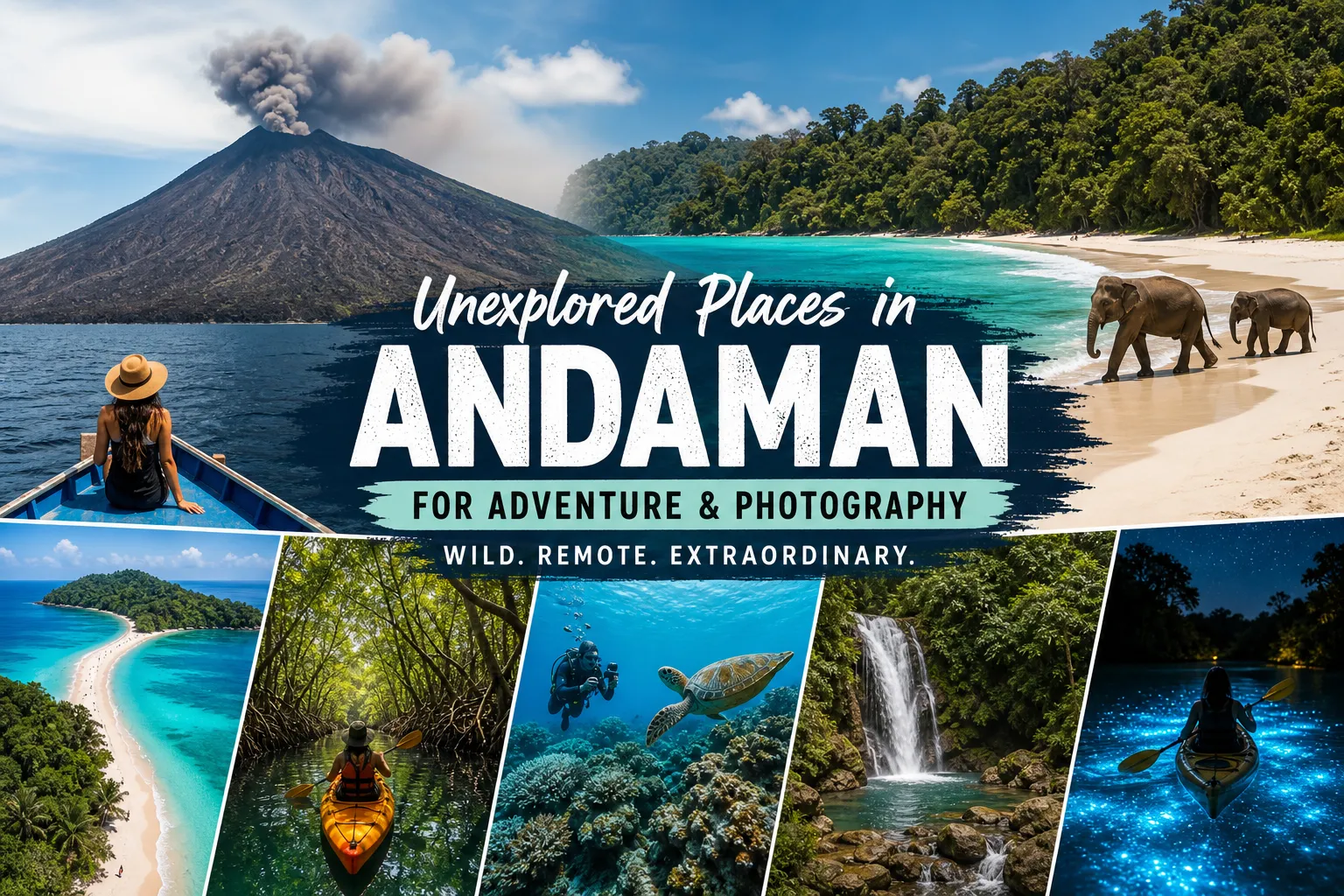
Unexplored Places in Andaman for Adventure and Photography
Uncover unexplored places in the Andaman Islands for adventure and photography—volcanic landscapes, hidden beaches, wild islands, and bioluminescent waters beyond the usual tourist trail.
Bharath M
May 5, 2026 • 11 min read
Where the wild things are — and where the light is extraordinary
Andaman is one of those rare destinations where the gap between what most tourists see and what actually exists is enormous. The popular islands deliver beauty on demand — the turquoise lagoons, the white sand, the coral reefs. But the Andaman that photographers dream about and adventurers seek out is a different archipelago entirely. It lives in the mangrove shadows, on the rim of an active volcano, at the edge of a rainforest that has never been logged, and on beaches that see more sea turtles than footprints. This is a guide to those places — the ones that reward the traveller who brings a camera and the willingness to go further than the ferry schedule suggests.
Barren Island — Photography at the Edge of the Earth
Some places exist beyond the ordinary imagination, and Barren Island is one of them. South Asia's only active volcano rises from the Bay of Bengal as a near-perfect cone of dark volcanic rock, its summit trailing a thin ribbon of smoke against whatever sky the day decides to offer — brilliant blue in the dry season, dramatically stormy in the transition months. Accessible only on Tuesday, shared boat trips from Havelock, the island rewards photographers with a visual drama that is almost impossible to replicate anywhere else in India.
The approach by boat is the first great shot — the volcano growing on the horizon, its silhouette hardening as you draw closer, the dark lava shoreline appearing at the waterline. Underwater, the diving is extraordinary: lava formations draped in coral, schools of barracuda moving in tight silver formations, manta rays in the deeper water, and visibility that regularly exceeds 25 metres. Above water, the juxtaposition of tropical sea and volcanic rock creates compositions of startling contrast.
For adventure photographers, the combination of a live dive beneath an active volcano — smoke rising above, coral blooming below — is a once-in-a-lifetime frame. Go early, go on a clear day, and bring a wide-angle lens for the approach shots and a waterproof housing for the dive.
Photography tip: Shoot the volcano silhouette at golden hour from the boat deck on the return journey — the light from the west catches the smoke plume and the dark rock in extraordinary ways.
How to reach: Shared boat from Havelock, Tuesdays only. Book well in advance.
Interview Island — Elephants on the Beach at Dawn
The image is almost impossible to believe until you see it yourself: wild elephants walking along a deserted beach at the edge of a tropical forest, the early morning sea glittering behind them, no other humans in sight. Interview Island — a protected wildlife sanctuary off the west coast of Middle Andaman — is where this image is real and where it can be yours, if you're willing to do the work to get there.
The island's feral elephant population, descendants of animals brought for logging in the early twentieth century, moves freely between forest and beach with no awareness of any boundary between the two. Photographing them requires patience, silence, and the willingness to sit still for long periods — which is to say, everything that produces great wildlife photography. The beaches themselves are vast and entirely pristine, offering compositions that combine white sand, turquoise water, and dense green forest in the kind of unspoiled proportion that exists almost nowhere else.
For adventure, simply being on Interview Island — no roads, no settlements, no infrastructure — is a frontier experience. You come by chartered boat, you bring everything you need, and you spend a day in a landscape that has been returned entirely to the wild.
Photography tip: Arrive at first light. The elephants are most active in the early morning, the quality of light is extraordinary, and the beach is at its most atmospheric before the heat of the day sets in.
How to reach: Charter a boat from Middle Andaman. Forest Department permits are required in advance from Port Blair.
Diglipur and the Far North — Light, Space and Empty Horizons
The far north of Andaman is a different country from the tourist south. Diglipur — the northernmost significant town in the island chain — sits at the edge of a landscape of extraordinary wildness: dense evergreen forest, dramatic coastline, and a sense of space that the busier southern islands simply cannot offer.
The twin islands of Ross and Smith, connected by their famous tidal sandbar, are among the most photographed natural formations in the region — but since so few visitors make it this far north, you will almost certainly have them to yourself. The sandbar at sunrise, with the sea on both sides catching the early light and the forested islands framing the horizon, is one of those compositions that travel photographers spend their careers looking for.
Saddle Peak — the highest point in the Andaman & Nicobar Islands at 732 metres — offers a full-day trek through undisturbed tropical rainforest to a summit with panoramic views across the entire northern archipelago. The forest itself is the photography: shafts of light through dense canopy, endemic birds at every turn, ancient trees draped in moss and epiphytes. And Ramnagar Beach during turtle nesting season (December to March) gives wildlife photographers the rare opportunity to document Olive Ridley and leatherback turtles coming ashore at night — one of nature's most moving spectacles.
Photography tip: For the tidal sandbar shot, set your alarm for 4:30 AM. The sandbar appears at low tide and the best light arrives within an hour of sunrise. By 9 AM, both the crowd (modest as it is) and the direct light will have changed the scene entirely.
How to reach: Flight (40 minutes) or overnight ferry from Port Blair. Plan for at least three nights in the Diglipur area.
Long Island — The Photographer's Quiet Paradise
Long Island does not advertise itself. It has no resort strip, no organised tour operators, and no particular reason to visit unless you are the kind of traveller who finds profound beauty in quietness and finds it easiest to photograph places that haven't been curated for consumption. Both descriptions apply here completely.
Lalaji Bay is a wide crescent of white sand that empties almost entirely outside of the handful of visitors who make the ferry journey, giving photographers unlimited access to a beach of exceptional composition. Mark Bay, a one-hour boat ride away on North Passage Island, requires a Forest Department permit and offers a beach that fewer than one percent of Andaman's visitors ever reach. Crystal-clear water over pristine coral, dense mangrove forest pressing to the shoreline, dolphins frequently spotted from the boat on the way over — every element of the journey and destination is photographic.
The mangrove trails and creek systems around Long Island are rich adventure territory — kayaking through narrow waterways where the canopy closes overhead and the water turns dark and still is an experience that rewards both the body and the lens. Bird life here is extraordinary: kingfishers, herons, sea eagles, and the white-bellied sea eagle are regularly sighted.
Photography tip: The boat journey to Mark Bay is as photographic as the destination — shoot the mangrove entrance from water level for dramatic perspective shots.
How to reach: Government ferry from Port Blair, Havelock, or Rangat. Plan for a minimum of two nights.
Neil's Cove — The Secret Lagoon on Havelock
Ten minutes from one of Asia's most celebrated beaches, Neil's Cove sits in almost total obscurity. A horseshoe-shaped lagoon framed by coral reef, volcanic rock formations, and forest — with water of a shade of teal that challenges any camera's white balance — the cove is visually extraordinary in a way that its famous neighbour cannot quite match because of the crowds.
The rock formations at the headland are architecturally dramatic: layered, angular, and worn smooth by millennia of wave action, they create natural frames and leading lines for landscape photographers. The lagoon itself — particularly in the morning light before the sun climbs too high — glows from within, the shallow sandy bottom visible through water so clear it barely seems to exist.
For adventure, the scramble across the rocks to reach the furthest viewpoint above the cove is a short but genuinely physical undertaking that rewards with a perspective shot of the entire lagoon from above — the kind of image that stops people mid-scroll.
Photography tip: The cove faces west — it is a sunset location, not a sunrise one. Arrive around 4:30 PM and stay until the light is gone.
How to reach: Walk northwest from Radhanagar Beach for 10–15 minutes. Go at low tide for the best access to the rock formations.
Little Andaman — Waterfalls, Surf, and the Unedited Shoreline
The four-hour ferry to Little Andaman is the best filter in the archipelago — it removes almost all casual tourist traffic and leaves behind only the travellers who genuinely want to be there. What awaits is an island of extraordinary natural variety: vast empty beaches, interior waterfalls, consistent surf, and a sense of genuine remoteness that is increasingly difficult to find in India.
Whisper Wave Waterfall and White Surf Waterfall tumble through dense tropical forest into natural rock pools — the kind of waterfall photography setting that requires nothing more than patience and timing. Butler Bay stretches for kilometres of completely undeveloped shoreline — long exposure surf photography here, with no structures or people to complicate the frame, produces images of pure elemental beauty. The interior forest, largely unexplored and rarely photographed, offers macro and canopy photography opportunities for those willing to venture off the beach.
For adventure photographers, the surf at Butler Bay presents a subject of constant motion and changing light. The early morning glass — before the sea breeze picks up — turns the wave faces into mirrors.
Photography tip: Shoot the waterfalls in the hours after rain when the flow is strongest. For Butler Bay surf shots, position low at water level for dramatic foreground spray.
How to reach: Government ferry from Port Blair — approximately 4 hours. Plan a minimum of two nights.
The Mangrove Creeks of South Andaman — Bioluminescence After Dark
This last entry has no single address because it exists across several locations — but it belongs on this list because it represents one of the most extraordinary photographic opportunities in the entire archipelago, and one that almost no tourist ever experiences.
On moonless nights between October and April, the tidal creeks and shallow lagoons of South Andaman — particularly around Havelock, Long Island, and the creek systems south of Port Blair — come alive with bioluminescence. Every disturbance in the water triggers a cascade of blue-green light from microscopic organisms. A paddle stroke. A fish rising. Your hand moving through the water. All of it glows.
Photographing bioluminescence is technically demanding — long exposures, a stable platform, and a very dark sky — but the results are images that seem to belong to science fiction rather than a real place. Kayaking tours after dark through mangrove creeks that glow with every movement of the water is also, independently of any photograph, one of the most magical experiences the islands offer.
Photography tip: Use a wide-angle lens, ISO 3200–6400, aperture f/2.8 or wider, and exposures between 15 and 30 seconds. A kayak is not a stable platform — anchor wherever possible for sharp results.
How to reach: Bioluminescence kayaking tours are operated from Havelock and some Port Blair operators. Book a guided tour — attempting it independently at night without local knowledge is not advisable.
Before You Pack Your Bags — and Your Camera
Go in the dry season. October to April is when the light is at its clearest, the sea is at its calmest, and the wildlife is at its most active. The monsoon months produce dramatic skies but make outer island travel genuinely unpredictable.
Protect your gear. Salt air, humidity, and the ever-present possibility of water exposure make weather sealing and dry bags non-negotiable. Clean your lenses and sensors every evening.
Get permits early. Interview Island, Mark Bay, and several trekking areas require Forest Department permits that cannot be obtained on the spot. Arrange them in Port Blair before departing.
Respect what you're photographing. Wildlife and pristine natural environments are the subjects here. The rule of minimum impact applies absolutely — to your presence, your noise, and the traces you leave behind.
Allow more time than you think you need. Every photographer who has visited these locations has said the same thing on leaving: more time is always needed. Plan for it from the beginning.
The Andaman Islands are one of the last places in India where the photograph you take can still be one that no one has taken before. That window is open — but it will not stay open forever. Go now, go far, and go quietly.
Follow Adventigo on Google Search
Add Adventigo as a preferred source to see our Andaman island travel guides, ferry schedules, and local tips prioritized in Google Search and AI Overviews.