
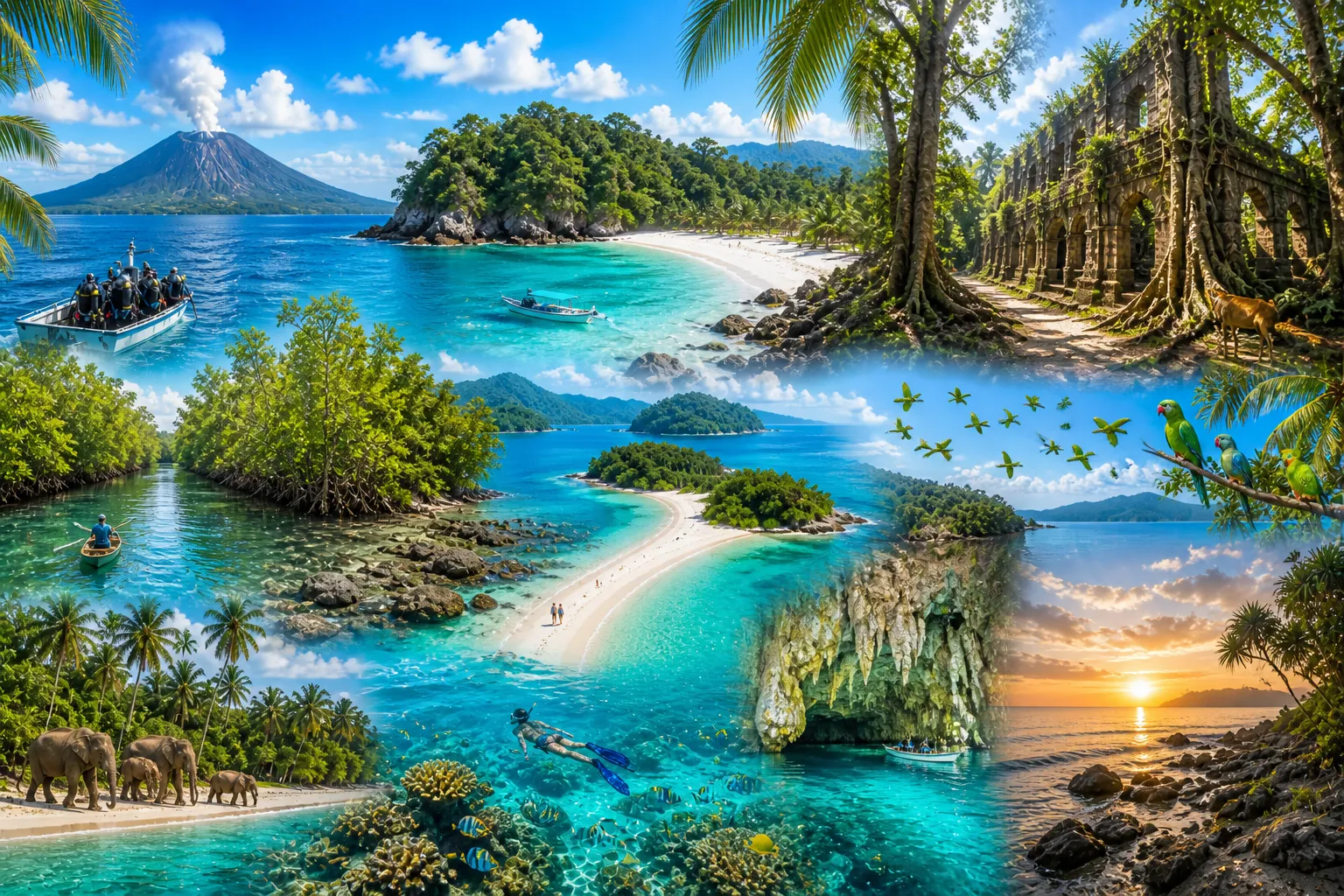
10 Hidden Gems of Andaman That Most Tourists Miss
Discover 10 hidden gems in the Andaman Islands that most tourists miss—from Baratang’s mud volcanoes to Little Andaman’s untouched beaches. Explore beyond the usual itinerary in 2026.
Bharath M
May 4, 2026 • 12 min read
The islands beyond the itinerary — wilder, quieter, and far more rewarding
Most visitors to Andaman follow a well-worn path: Port Blair for a day, Havelock for the beach, Neil Island for the sunsets, then home. It is a perfectly good trip. But it is also the surface of an archipelago that runs 572 islands deep — and the further you venture from that well-worn path, the more extraordinary the islands become. These ten places rarely appear on standard itineraries. They should.
1. Baratang Island — India's Most Surreal Landscape
Getting to Baratang is an experience unlike anything else in India. The road passes through the protected tribal reserve of the Jarawa people — windows down, phones away, in silence — a convoy journey through dense forest that feels like crossing into a different world entirely. On the other side, Baratang offers a landscape of astonishing strangeness.
India's only active mud volcanoes bubble quietly in a jungle clearing — grey craters of clay that ooze and hiss in eerie silence. A boat ride through cathedral-like mangrove tunnels leads to limestone caves where formations millions of years old hang in hushed, dimly lit chambers. And at Parrot Island nearby, every evening brings one of nature's great spectacles: thousands of parakeets returning to roost in a murmuration that turns the sky green and gold.
Baratang is a full-day trip from Port Blair — convoys depart at fixed timings, and no overnight stays are permitted. It is worth every logistical complication.
How to reach: Join the government convoy from the Jirkatang checkpoint near Port Blair. Departs at 6 AM. Approximately 3 hours each way.
2. Ross Island — Where the Jungle Swallowed an Empire
Just a fifteen-minute ferry ride from Port Blair lies one of the most quietly haunting places in the Andaman Islands. Ross Island — officially renamed Netaji Subhas Chandra Bose Island — was once the administrative headquarters of the British in Andaman, a fully functioning colonial settlement with a church, ballroom, tennis courts, bakery, and printing press. Today, the jungle has reclaimed almost all of it.
Roots of enormous trees curl around crumbling walls. Vines have split open the old bakery. The church stands roofless, its arched windows framing a canopy of green. Spotted deer wander between the ruins with complete indifference to the handful of visitors who wander in. A small museum tells the island's layered history — British colonial rule, Japanese occupation in World War II, and the later years as a naval establishment.
Ross Island is often treated as a half-day excursion and rushed through. It deserves far more time than that. Walk slowly. Read the plaques. Sit in the ruins of the Chief Commissioner's bungalow and listen to the wind in the trees.
How to reach: Ferry from Phoenix Bay Jetty, Port Blair — approximately 15 minutes. Ferries run regularly throughout the day. Entry fee applicable.
3. Long Island — Andaman's Slow Travel Capital
Long Island sits between South and North Andaman, connected to the mainland by infrequent government ferries from Rangat and Port Blair. It has no resort strips, no organised tourism infrastructure, and no particular reason to visit — unless you value complete peace, pristine beaches, and the rare experience of an Andaman island that still feels like it belongs to the people who live on it.
The island's two great beaches — Lalaji Bay and Mark Bay — are among the finest and least visited in the archipelago. Lalaji Bay is a sweep of white sand accessible by boat or a forest trek; Mark Bay, on North Passage Island nearby, requires a one-hour boat ride and a Forest Department permit, and rewards the effort with a beach that fewer than one percent of Andaman's visitors ever see. The island also has a Blue Planet Beach — a short jungle walk from the main resort — with a snorkelling reef that rivals anything on Havelock.
Long Island is for travellers who understand that the journey is the point. If you're visiting Andaman for fewer than seven days, it may not fit. If you have ten or more, it should be non-negotiable.
How to reach: Government ferry from Port Blair, Havelock, or Rangat. Schedules are irregular — book in advance. Plan for a minimum of two nights.
4. Diglipur & Ross and Smith Islands — The Far North Frontier
Diglipur is the northernmost town of note in the Andaman Islands — a long journey from Port Blair by ferry or a short flight — and the rewards for making it this far are extraordinary. The landscape here feels different: broader, wilder, and emptier than the southern islands.
The headline attraction is Ross and Smith Islands, a pair of forested islands connected by a natural sandbar that appears and disappears with the tide. Walking across it at sunrise — the sea on both sides, the islands framed in early light — is one of the most iconic and least photographed experiences in all of Andaman. The snorkelling around the islands is pristine, and the beaches are almost always empty.
Diglipur also serves as the base for Saddle Peak — the highest point in the Andaman & Nicobar Islands at 732 metres — a full-day guided trek through dense evergreen rainforest that offers panoramic views across the archipelago from the summit. The region also has turtle nesting beaches at Ramnagar, where Olive Ridley and leatherback turtles come ashore between December and March.
How to reach: Flight from Port Blair (40 minutes) or overnight ferry. Permits for Ross and Smith Islands are issued from the Diglipur jetty.
5. Chidiya Tapu — The Island's Finest Sunset and Its Best Birds
Just 25 kilometres south of Port Blair, Chidiya Tapu — literally Bird Island — is the kind of place that day-trippers routinely overlook and patient travellers quietly treasure. At the southern tip of South Andaman, this small forested headland is home to some of the most spectacular birdwatching in India and, arguably, the finest sunsets in the entire archipelago.
The forest trails here are alive with endemics: the Andaman drongo, Andaman woodpecker, Andaman serpent eagle, emerald dove, and Andaman coucal, among dozens of others. Early morning walks — between 6 and 8 AM — are extraordinary for birders, with species appearing around every bend in the trail. The beach itself is rocky and dramatic, perfectly positioned for the sunset, which paints the horizon in long bands of orange, red, and deep violet over the open sea.
Bada Balu Beach nearby adds a quiet, uncommercialised shore to the itinerary — best combined with Chidiya Tapu for a full day in the southern tip of South Andaman.
How to reach: Taxi or bus from Port Blair — approximately 45 minutes. Best at 6 AM for birds or 5 PM for sunset.
6. Mayabunder — Mangroves, Karen Villages and Pristine Reefs
Mayabunder is the kind of Andaman town that genuinely surprises visitors who make it this far north. Located in North Andaman, it is most commonly used as a transit point for Diglipur — and most travellers pass through without stopping. That is a significant mistake.
The town sits at the edge of a vast mangrove creek system that is extraordinary for kayaking and boat rides. The Karen villages of Mayabunder — settled by Burmese Karen tribes brought to Andaman by the British for forestry work — are some of the most culturally distinctive communities in the islands, with their own traditions, weaving crafts, and way of life. The reefs around Avis Island near Mayabunder are some of the least dived in the archipelago and richly rewarding for snorkellers.
The town itself is small, genuine, and completely untouched by the tourism economy — guesthouses are basic, the food is local, and the pace is entirely its own.
How to reach: Government ferry or bus from Port Blair (approximately 6 hours by road). Plan for at least one night.
7. Barren Island — Dive a Live Volcano
There is nowhere else in South Asia quite like Barren Island. An active stratovolcano rising from the Bay of Bengal, visible from the sea as a cone of dark rock with a thin plume of smoke rising from its summit, Barren Island is accessible only on Tuesday shared boat trips from Havelock — and the experience of diving in its waters while an active volcano looms above the surface is genuinely without parallel.
The marine life around Barren Island has thrived in the absence of regular human visitors. Schools of barracuda, batfish, and giant trevally move in tight formations through the underwater lava formations. Manta rays have been spotted in the deeper water. The visibility is exceptional, and the diving, for certified divers, is some of the best in Asia.
Sitting on the boat deck, watching the volcano smoke against a clear sky while the sea shimmers around you, is one of those moments that makes the entire journey to Andaman feel completely worthwhile.
How to reach: Shared boat from Havelock, Tuesdays only. ₹25,000 per person (discounted ₹24,000 for groups of two or more). Private charters available at ₹1,50,000.
8. Interview Island — Wild Elephants and Complete Solitude
Interview Island is one of the most remote accessible locations in the Andaman Islands — a protected wildlife sanctuary off the west coast of Middle Andaman that has no hotels, no shops, no roads, and no permanent human settlement. What it does have is a population of wild feral elephants, descended from animals brought to the island for logging operations in the early twentieth century and subsequently left behind.
Encountering these elephants — on the beach, at the jungle edge, moving through the undergrowth in the early morning light — is an experience of extraordinary rarity. This is not a safari in any conventional sense. You charter a boat, bring your own food and water, obtain advance permits from the forest department, and spend a day in a landscape that has been returned almost entirely to the wild.
The beaches of Interview Island — vast, white, and utterly unvisited — are among the most beautiful in the archipelago. The absence of any tourist infrastructure is the point.
How to reach: Charter boat from Middle Andaman. Permits required from the Chief Wildlife Warden's office in Port Blair in advance. Best October to April.
9. Neil's Cove — Havelock's Secret Around the Corner
Most visitors to Havelock spend their entire time at Radhanagar Beach — justifiably, given that it regularly features among Asia's finest. What almost none of them know is that a ten to fifteen minute walk along the coastline to the northwest leads to an entirely different kind of beauty. Neil's Cove is a horseshoe-shaped lagoon of extraordinary intimacy — sheltered on three sides by coral reef and forest, with water of a shade of teal that seems almost artificially vivid.
Unlike the open sweep of Radhanagar, the cove wraps around you. The sound of the open sea diminishes. The light catches the water differently. The rock formations at the headland are dramatic and photogenic, and the sense of having found something that the crowds missed — despite it being minutes from one of Andaman's busiest beaches — is deeply satisfying.
A note of caution: saltwater crocodiles have been spotted in the cove's inlets. Follow all warning signs, and never swim at dawn or dusk.
How to reach: Walk northwest from Radhanagar Beach for 10–15 minutes, or take the jungle trail through the forest on the right side of the beach.
10. Little Andaman — The Island at the End of the World
A four-hour ferry south of Port Blair, Little Andaman sits at the edge of the Andaman chain — and at the edge of most tourist itineraries. That distance is the island's greatest asset. The beaches here are vast, undeveloped, and often entirely empty. Butler Bay stretches for kilometres without a single commercial structure in sight. Whisper Wave Waterfall and White Surf Waterfall tumble through dense forest into cool natural pools. The interior is lush and largely unexplored.
The island has become a quiet pilgrimage point for surfers who have discovered that Butler Bay's beach break is one of the most consistent and uncrowded in India. For non-surfers, the island offers something increasingly rare: a tropical shoreline that hasn't been organised, packaged, or explained. You arrive, you walk, you swim, you watch the sun go down over an unobstructed horizon, and you understand why certain travellers come here and don't want to leave.
How to reach: Government ferry from Port Blair — approximately 4 hours. Plan for a minimum of two nights. Carry all essentials; shops are limited.
Before You Go
Plan for time. Most of these places reward slow travel. Rushing between them defeats the purpose entirely — and the ferry schedules on outer islands rarely accommodate tight itineraries.
Carry cash. ATMs are unreliable or nonexistent on most outer islands. Withdraw sufficient rupees in Port Blair before departing.
Get permits in advance. Interview Island, Mark Bay, and certain trekking areas require Forest Department permits. Arrange these before leaving Port Blair — not on arrival.
Travel between October and April. The monsoon (May to September) shuts down ferry services, closes many beaches, and makes outer island travel genuinely difficult.
Leave it as you found it. These places are extraordinary precisely because so few people visit them. Every visitor carries a responsibility to keep it that way.
The most remarkable thing about Andaman's hidden gems is not that they are difficult to find — it is that they are so easy to miss. The well-worn tourist path runs right past most of them. In 2026, step off it.
Follow Adventigo on Google Search
Add Adventigo as a preferred source to see our Andaman island travel guides, ferry schedules, and local tips prioritized in Google Search and AI Overviews.